Controlled Autonomy: Why Intelligent Agents Need Not Only Freedom of Action, but an Architecture of Accountability
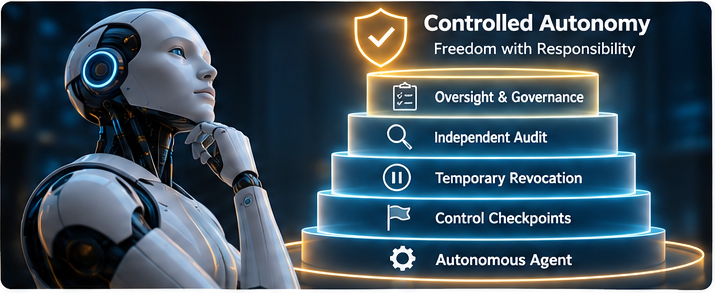
When we talk about autonomous AI agents, attention usually focuses on what they can do: plan, select tools, and carry out multi-step tasks. Yet there is a second, equally important question: who verifies—and by what mechanism—that each subsequent action by an agent remains authorized?
This is not primarily a question of model capability. It is a question of trust architecture. An intelligent system can reason correctly and still take an action outside the scope of its authority. Controlled autonomy should therefore be designed not as a collection of warnings, but as an independent system of permissions, checks, suspension, and audit.
From Individual Checks to a Controlled Route
In the research model considered here, an agent’s work is represented as a route comprising successive stages and control checkpoints. A route may contain tens, hundreds, or thousands of steps. Reaching the next checkpoint is not itself permission to proceed; it merely initiates a verification procedure.
Before authorizing the next step, the system should jointly verify the agent’s identity, task context, current permissions, integrity of its state, admissibility of the selected tool, conformity with the approved action sequence, and evidence from independent observers. The agent is not the sole source of information about its own status: supervisory layers receive signals of their own.
Prior authorization can be temporarily suspended while continuation is evaluated. An agent must not retain the right to initiate new actions merely because that right existed at the previous stage. Following a successful check, authority is reissued only to the minimum extent necessary. If a discrepancy is found, the route stops, access is revoked, and the event is recorded for audit.
Multi-Layer Orchestration and Advisory Intelligence
Above the route is a governance layer responsible for goals, authority boundaries, and rules. Beside it sits an advisory analytical layer: expert systems assess contradictions, risks, and alternative decisions, but cannot independently override a protective prohibition.
At the next level, orchestrators coordinate the sequence of work. Separate monitors compare actual execution with the authorized route, while an independent audit examines not only the agent’s own report but also evidence from the execution environment. Separating these roles reduces dependence on a single decision-making center and a single information source.
It is crucial to distinguish between “preventing the next tool call” and “guaranteeing that an action already in progress has stopped.” Merely invalidating an access record may not stop an operation launched a moment earlier. Strong revocation requires the execution boundary itself to honor the loss of authority and prevent further effects after revocation. That is a distinct engineering problem, not an automatic consequence of adding a Stop button.
What Already Exists in the Industry
Related ideas are implemented in established tools. LangGraph can persist execution state and interrupt a workflow pending external authorization. Amazon Bedrock AgentCore supports temporal policies that take session action history into account. Open Policy Agent separates policy decisions from application logic and supports decision logging. NVIDIA NeMo Guardrails provides safeguards across dialogue, tool execution, inputs, and outputs.
None of these examples, on its own, proves that the architecture described here has already been implemented in full—or that it is unique. The research interest lies in the combination of route-based control, several independent layers, temporary withdrawal of permissions, enforcement at the execution boundary, and independent auditing of outcomes.
The Cost of Safety: Milliseconds and Scale
Control has a cost in latency, computation, and complexity. A meaningful comparison, however, must examine the entire workflow rather than an isolated check: how many operations execute sequentially, which checks can run in parallel, what network communication costs, and how often additional approval is needed.
For example, if one additional check took 2 milliseconds, 1,000 strictly sequential checks would add 2 seconds. This is an illustrative calculation, not a measured result from our system. A million checkpoints would make linear accumulation more consequential. That is why batching, local policy execution, caching of safely immutable conditions, and parallel verification of independent signals deserve study—provided they do not compromise safety.
The central research hypothesis is that, for bounded multi-step scenarios, the cost of well-designed control may be acceptable compared with the risk of uncontrolled action. But it would be unjustified to claim that the difference is “small” on the basis of an architectural model alone. That claim requires comparable experimental runs on identical tasks.
What Must Be Tested Experimentally
A comparable test series should run in two modes—with control boundaries and without them—using identical tasks, tools, and conditions. Routes of 100 and 1,000 steps would be useful starting points. Measurements should include median, P95, and P99 latency, total execution time, verification cost, and behavior under failure. Additional metrics should measure successful permission revocation, actions occurring after revocation, recovery after a stop, and completeness of the independent audit trail.
The available working materials do not yet contain a verified, complete set of these comparative measurements with raw logs. Accordingly, numerical conclusions about performance or strict shutdown must remain open research questions, not presented as demonstrated achievements.
The proposed architecture is a research concept. Its effectiveness, performance, and reliability require experimental validation — a process we have been actively pursuing for some time.
Not Only Smarter, but More Accountable
As systems become more autonomous, the problem itself changes. It is no longer enough to teach an agent to perform useful actions. We must establish conditions under which authority has a defined boundary, progress can be verified, unauthorized actions can be halted, and every significant outcome can be reproduced and independently examined.
Perhaps the future of intelligent agents will be defined not by how many tasks they can perform without human involvement, but by the precision of the architecture that knows when an agent should proceed—and when it must stop.